Rocket Lab: Flying Under the Radar
I am long Rocket Lab with a 5-plus year time horizon.
While SpaceX is a household name at this point with its $400 billion market cap, up and coming space company Rocket Lab has similarly lofty goals but has thus far been flying under the radar.
The industry has unfortunately been marred by hype and a lack of execution, but while previous contemporaries such as Virgin Galactic, Astra, Virgin Orbit and others failed to live up to their lofty promises, Rocket Lab has been steadily proving that there can be substance behind the hype for publicly traded space companies.
Rocket Lab's Electron rocket is the second most frequently launched commercial rocket behind SpaceX's Falcon 9 with 64 successful launches to date, and it is actually ramping up at a faster rate than SpaceX managed with the Falcon.
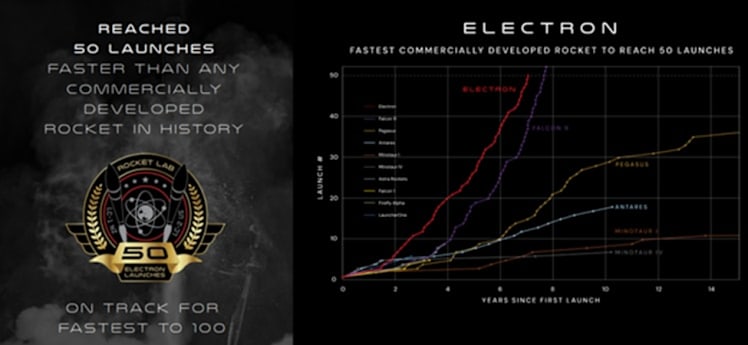
Rocket Lab is also taking that experience with Electron and building a much larger Neutron rocket that will help break SpaceX's stranglehold on the industry, with a projected first launch at the end of the year.
The secret with space companies is that the real magic happens when you have both launch capability and satellite manufacturing capability paired together — and Rocket Lab has been steadily expanding its satellite manufacturing capacity since going public. Rocket Lab's satellite manufacturing division has seen a compound annual growth rate of a whopping 213% per year since 2021, driven by high-profile contracts including Apple's emergency messaging constellation, part of the U.S. government's defense and missile tracking constellation, a mission to the moon, two satellites due to launch for Mars, and more.
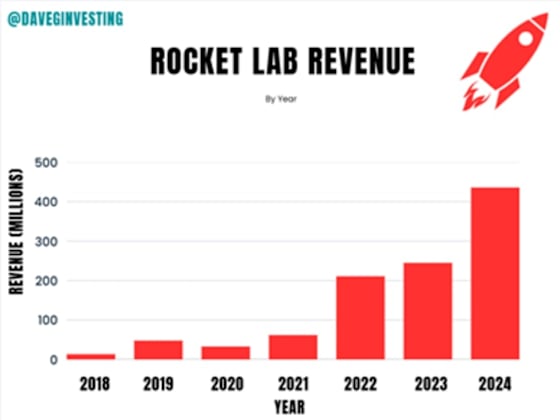
These growth numbers have been driven in part by several savvy acquisitions to bring all satellite components and software in-house. Combine that with a record ramp of Electron launches and Rocket Lab's revenue growth has been extremely impressive to watch.
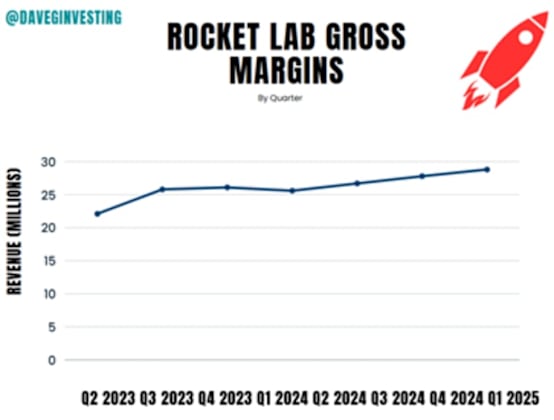
Gross margins continue to expand as the company scales, with an eventual target of 50% for current products looking achievable.
However, these business lines are really just setting the stage for Rocket Lab's next phase of growth — their own satellite constellation. Once you can bring launch together with completely vertically integrated satellite production, you can launch your own satellites and generate high-margin recurring revenue from orbit. This has already been demonstrated with SpaceX's Starlink constellation, propelling them to a $400 billion valuation at a price and scale that legacy satellite providers simply can't match.
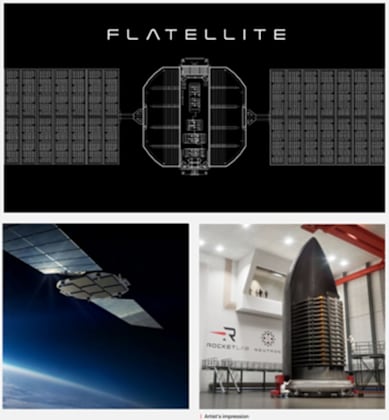
Rocket Lab recently announced Flatellite — their next-gen satellite model that will be used to provide their own satellite services from orbit.
The company is also well capitalized, with over $400 million in cash and a shelf offering they can tap at any time. Management is best in the industry, led by founder and CEO Sir Peter Beck — who guided the company from a tiny startup to a $20+ billion space company. He is widely regarded as not only an excellent leader but an unmatched engineer, with a similar devotion to his company that Elon Musk previously displayed.
All the pieces are in place for this company to become something truly special.